What Japanese Museums Know About Showing Less and Meaning More
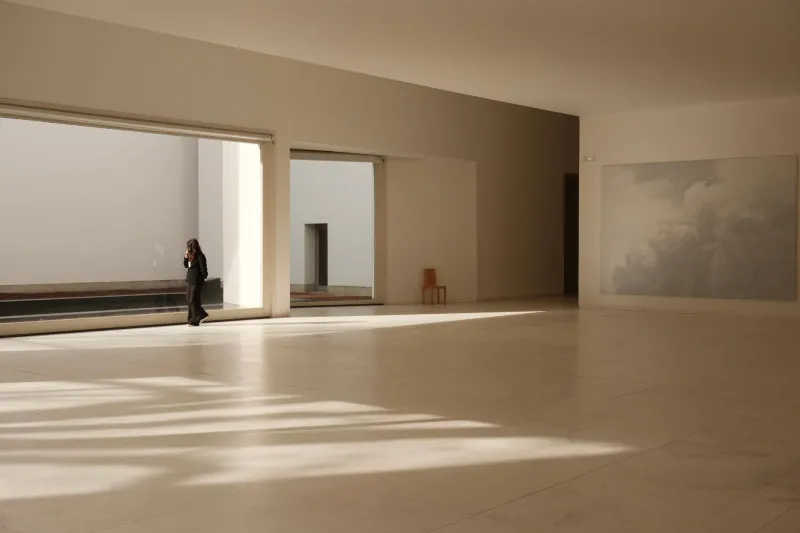
Walk into a major American gallery and you'll often feel like you're being yelled at. Work stacked floor to ceiling, plaques everywhere, a kind of visual noise that mistakes volume for value. Now picture a small museum in Kyoto — a single ceramic bowl in a dimly lit alcove, a few inches of empty wall on every side, and somehow you can't look away. That contrast says everything.
Japanese curatorial philosophy has always operated from a different set of assumptions. The goal isn't to show you everything. It's to make you feel something about the one thing in front of you.
And slowly, American creators are catching on.
The Edit Is the Art
In Japan, the idea of ma — that meaningful negative space between things — shows up everywhere, from architecture to music to conversation. In museums and galleries, it translates into a curation style that treats empty wall space not as wasted real estate, but as part of the composition itself.
That's a radical idea by Western standards. Most of us grew up equating more with better. More work on display means more to see. More content means more value. More product means more credibility. But Japanese curators have long argued the opposite: the act of choosing what not to show is where the real skill lives.
When a single scroll painting hangs alone in a traditional Japanese tokonoma alcove, the emptiness around it isn't absence — it's framing. It tells you where to look. It tells you this matters. It makes the object feel chosen, not just placed.
What This Looks Like for Creators Right Now
Here's where it gets practical. Think about how most creators present their work online. The portfolio with 47 pieces. The Instagram grid crammed with content. The Bandcamp page with 12 albums and 30 singles. The instinct is to show everything because everything represents effort, and effort feels like proof.
But audiences don't experience it as proof. They experience it as homework.
Creators who've studied or simply absorbed Japanese curatorial sensibility — whether through travel, formal training, or just deep admiration — are starting to flip the script. They're building portfolios with ten pieces instead of fifty. They're releasing one project at a time, fully finished, before moving on. They're letting silence exist on their platforms without rushing to fill it.
And weirdly? People pay more attention.
When everything is curated, nothing feels throwaway. The audience understands, maybe subconsciously, that what they're seeing has been chosen with intention. That changes how they receive it.
The Museum as a Model, Not a Metaphor
It's worth looking at specific institutions to understand how this philosophy actually gets applied. Japanese prefectural museums, smaller private collections, and spaces like the Nezu Museum in Tokyo or the Miho Museum in Shiga operate with a patience that's almost meditative. Exhibits are sparse by design. Objects are often displayed in rotation, meaning you might visit three times and see three different configurations of the same collection.
That rotation is a curatorial statement in itself. It says: this collection is larger than what we're showing you. It creates a sense of depth and restraint simultaneously. Visitors leave wanting to come back, not because they didn't see enough, but because what they did see felt complete and yet hinted at more.
American creators can build that same dynamic into their work. The musician who drops one carefully chosen single and then goes quiet for two months. The visual artist who shares one piece a week with a short, considered note instead of flooding their feed daily. The writer who publishes one essay a month instead of churning out content five days a week. These aren't strategies born from laziness — they're born from the same curatorial instinct that makes a Kyoto museum feel sacred.
Editing Yourself Is the Hardest Part
Here's the uncomfortable truth: editing your own output is genuinely difficult. It requires a kind of confidence that doesn't come naturally when you're building an audience and the algorithm rewards consistency above almost everything else.
Japanese curators don't have that problem in quite the same way — their role is explicitly editorial. But for independent creators wearing every hat at once, the decision to hold something back, to not post, to remove a project from your portfolio, to sit on a release until it feels truly ready — that takes discipline.
It also takes trust. Trust that your audience would rather wait for something meaningful than be fed something mediocre on schedule. Trust that restraint reads as confidence, not absence.
Some creators are building that trust deliberately. They're talking openly with their communities about why they don't post every day, why their catalog is intentionally small, why they're not in a rush. That transparency turns the editorial choice into part of the story itself.
Less Really Does Land Harder
There's a reason why a single well-lit object in a Japanese museum stops you in your tracks when an entire wall of paintings might not. The eye needs somewhere to rest. The mind needs space to make meaning. When everything is competing for attention, nothing wins.
The creators figuring this out right now aren't necessarily making better work than everyone else — though many of them are. They're just presenting it with more intention. They're trusting the edit. They're letting the empty space do some of the work.
That's not a new idea. Japanese museums have been proving it for centuries. It just took the rest of us a while to look closely enough to notice.